

How too much exercise can kill you, and what you can do to protect your heart.
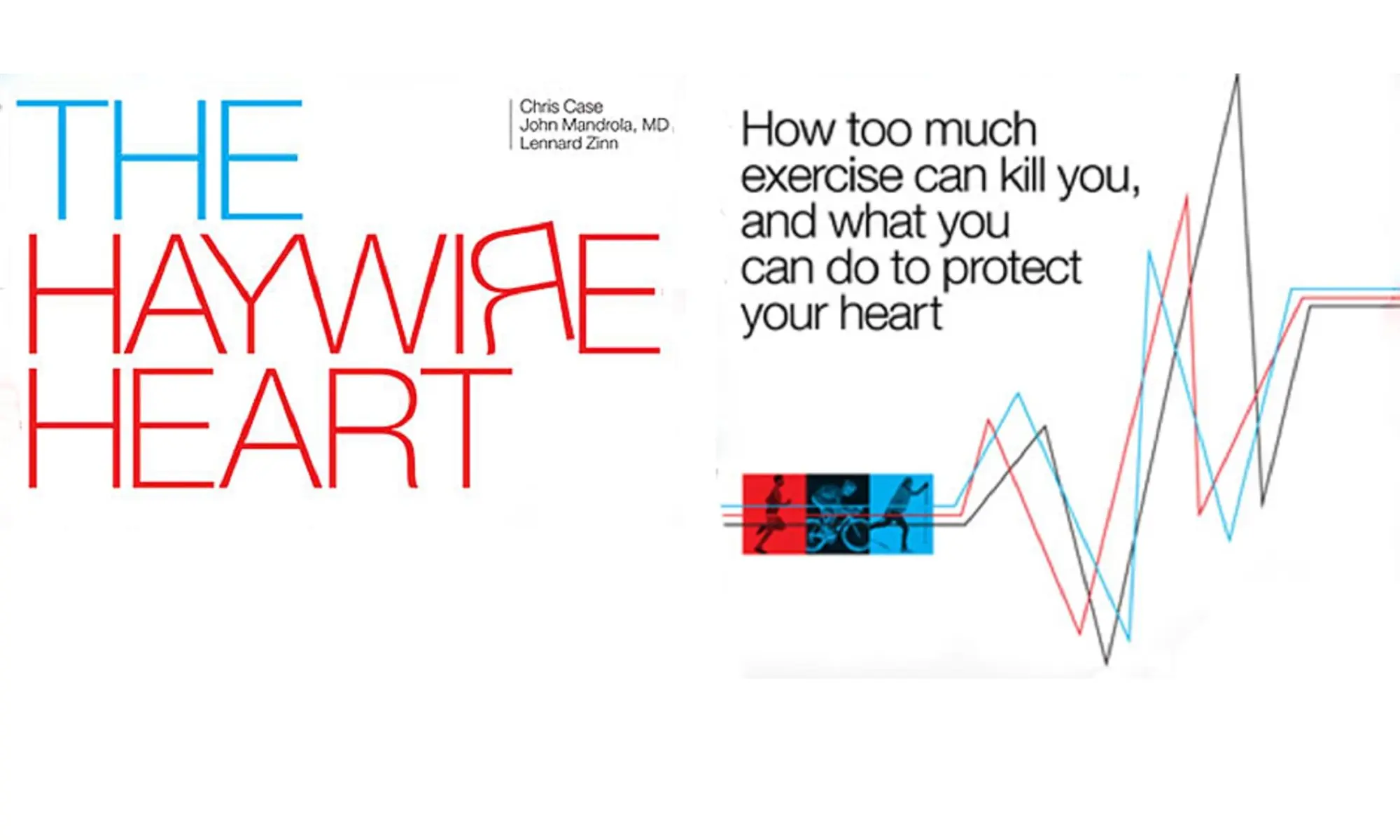
Inspired by Chris Case, John Mandrola, and Lennard Zinn
Exercise is good for the heart. Few statements in health science sound safer than this one. Regular physical activity lowers the risk of cardiovascular disease, improves metabolic health, and is associated with a longer life.
Then along comes a book titled The Haywire Heart: How Too Much Exercise Can Kill You, and What You Can Do to Protect Your Heart.
Its authors—Chris Case, cardiac electrophysiologist John Mandrola, and endurance athlete Lennard Zinn—argue that years of intense endurance training can damage the heart. They focus particularly on cyclists, runners, triathletes, and cross-country skiers who train hard for decades, often while treating recovery as an optional activity for less ambitious people.
The book describes what is sometimes called the athlete’s heart: the structural and electrical adaptations caused by long-term training. Most of these changes are normal and beneficial. In some athletes, however, repeated strain may contribute to atrial enlargement, inflammation, fibrosis, and electrical instability. The possible consequences include atrial fibrillation, atrial flutter, tachycardia, and other rhythm disorders.
The warning is supported by research. A 2021 systematic review found that athletes had a higher likelihood of developing atrial fibrillation than non-athletes, with the strongest association among endurance athletes and athletes participating in mixed sports.
The conclusion appears straightforward: exercise protects the heart—until there is too much of it.
Unfortunately, or perhaps fortunately, science rarely stays straightforward for long.
The view from the other side
A large study published in JAMA Network Open examined more than 122,000 people who had undergone exercise treadmill testing. The researchers found that higher cardiorespiratory fitness was associated with lower mortality. The people classified as elite performers had the lowest risk of death, and the researchers found no upper limit beyond which greater fitness became harmful.
Another analysis, based on data from more than 660,000 adults, reached a similar conclusion. Most of the longevity benefit appeared at approximately three to five times the recommended minimum amount of physical activity. Beyond that point, the benefit stopped growing substantially—but even people reporting more than ten times the recommended minimum did not have increased mortality.
So, does extreme exercise damage the heart, or does exceptional fitness help us live longer?
The mildly irritating answer is: both findings may be true.
The studies are asking different questions
The Haywire Heart concentrates on particular cardiac conditions, especially atrial fibrillation. The large population studies concentrate mainly on death from all causes.
These are not interchangeable outcomes.
A group of endurance athletes may develop atrial fibrillation more frequently and still live longer, on average, than an inactive population. Exercise can increase one particular risk while simultaneously reducing the risks of coronary disease, diabetes, obesity, stroke, and several cancers. Biology does not have to choose one side of the debate merely because we would prefer a clean headline.
There is another important distinction. High fitness is not identical to a high volume of training. Fitness is an outcome influenced by exercise, genetics, age, health, and many other factors. Training volume is an exposure. A person can possess exceptional aerobic capacity without continually exhausting the body, while another can accumulate enormous training hours without reaching the same level of fitness.
The groups being compared also matter. Elite athletes are a highly selected population. To become an elite athlete, a person generally needs favourable genetics, excellent health, years of adaptation, and the ability to survive the training required to get there. Studying those who reach the top may tell us less about those whose bodies objected somewhere along the way and quietly left the experiment.
Alcohol joins the discussion
The book also identifies alcohol as an important irritant to the heart and a potential trigger for atrial fibrillation. Several studies support a dose-dependent association: as alcohol consumption rises, so does the risk of developing the arrhythmia. A randomized trial involving regular drinkers who already had atrial fibrillation found that abstinence reduced recurrences and the overall burden of the condition.
But this subject has produced conflicting findings too. Some observational studies have found little or no increase in atrial fibrillation among light drinkers. Others have suggested a J-shaped relationship, in which moderate drinkers appear to have outcomes as good as—or occasionally better than—abstainers.
That does not prove that a glass of wine is cardiac medicine. People who drink moderately may differ from abstainers in income, diet, social life, previous health, and access to medical care. A group described as “non-drinkers” can also include former drinkers who stopped because they were already ill. Alcohol research contains enough confounding factors to make a glass of red wine look almost innocent. Almost.
The most defensible conclusion is narrower: heavy and frequent alcohol consumption increases the risk of atrial fibrillation, while the effect of very small quantities is more difficult to establish precisely. For a person who already experiences arrhythmia, reducing alcohol is a reasonable experiment—preferably a more controlled one than changing alcohol, sleep, diet, stress, and training simultaneously and then declaring that one of them performed a miracle.
A disagreement created by perspective
The apparent contradiction surrounding endurance exercise is a useful lesson in reading science.
Before deciding that two studies disagree, we should ask:
- Did they measure illness, symptoms, fitness, or mortality?
- Did they study professional athletes, recreational athletes, patients, or the general population?
- Did they measure present fitness or decades of training?
- Are they reporting relative risk or absolute risk?
- Is the evidence observational, or was an intervention tested?
- Does the result apply to everyone or mainly to a particular group?
A fivefold increase in a rare condition may still represent a small absolute risk. A lower overall risk of death does not mean that every organ benefits equally from every training dose. And an association between two variables does not automatically tell us that one caused the other.
This is not a defect in science. It is what happens when science attempts to describe a complicated organism living in a complicated environment.
The value of continuing to look
The easiest response is to select the study that confirms what we already wanted to believe. Athletes can quote the research showing that exceptional fitness predicts longevity. People who prefer the sofa can point to The Haywire Heart and announce that they are merely protecting themselves from atrial fibrillation.
Neither group has understood very much.
A more useful conclusion is that regular exercise remains one of the most reliable ways to improve health, while decades of extreme endurance training may carry specific risks for some people. Symptoms such as sustained palpitations, chest pain, fainting, unusual breathlessness, or a sudden unexplained decline in performance should not be treated as proof of admirable commitment. Sometimes the body is not asking for greater discipline. Sometimes it is asking us to stop being ridiculous.
The larger lesson extends beyond exercise and alcohol. The same evidence can produce apparently opposing conclusions when researchers examine different populations, outcomes, doses, and periods of time. A headline gives us an answer; careful reading reveals the question that was actually asked.
That is why intellectual curiosity requires more than finding a source. It requires looking for the source that disagrees with it, understanding why it disagrees, and deciding whether the contradiction is genuine or only apparent.
Knowledge rarely ends with the first convincing explanation. More often, that is where it begins.
Sources
- Case, C., Mandrola, J., and Zinn, L., The Haywire Heart: How Too Much Exercise Can Kill You, and What You Can Do to Protect Your Heart
- Newman et al., Risk of atrial fibrillation in athletes: a systematic review and meta-analysis
- Mandsager et al., Association of Cardiorespiratory Fitness With Long-term Mortality Among Adults Undergoing Exercise Treadmill Testing
- Arem et al., Leisure Time Physical Activity and Mortality
- Voskoboinik et al., Alcohol Abstinence in Drinkers with Atrial Fibrillation
- Case, Mandrola, and Zinn, excerpt concerning alcohol and other heart irritants